

 i
iRaw Deal: How Wall Street and Washington broke faith with working families
As hard times linger, unemployed workers are grappling with shame, anxiety and depression. They are cutting costs, losing health care coverage and worried about retirement. They fear their children’s generation will be worse off than theirs.
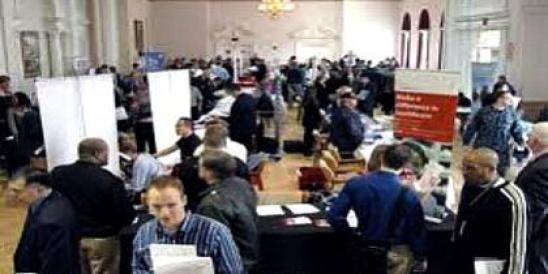
Job fair in New York Kathy Willens/AP
Yet they still believe in the American dream.
Those are the findings of a new poll of out-of-work Americans conducted by The New York Times and CBS News. When asked if they think it is still possible “to start out poor in this country, work hard and become rich,” a robust 67 percent of the unemployed said yes— just a few points less than the 75 percent of all Americans who replied in the affirmative.
The jobless workers’ faith in America, however, does not extend to its political and economic systems, or to their current cast of elected leaders. When asked who is to blame for the nation’s high unemployment rate, one out of five jobless workers chose “politicians.” It was the leading explanation, more than double the rate given by out-of-work Americans just two years ago.
Some 60 percent of the unemployed disapprove of President Obama’s handling of the economy, and his efforts to create jobs. More than a third believes the Democratic president favors the rich.
But 81 percent disapprove of Congress, and just 15 percent think that congressional Republicans have a clear plan for creating jobs. And 82 percent of the unemployed think Republicans favor the rich. Only 5 percent believe that the GOP’s policies help the middle class.
The American dream may still be a viable promise for these folks, but 77 percent think the distribution of money and wealth in the United States is unfair.
Their feelings echo the latest scholarly finding, by the Congressional Budget Office , of growing economic inequality in America.
According to the CBO study, average real after-tax income in the last three decades grew “much faster” for the richest 20 percent of Americans than for the other four-fifths of the population—so much so that “the after-tax income receive by the 20 percent of the population with the highest income exceeded the after-tax income of the remaining 80 percent” combined.
And the very rich profited immensely. The CBO found that the top 1 percent of Americans saw their incomes grow by a whopping 275 percent in that period, as federal tax and benefits laws increasingly favored the wealthy. Middle class incomes over those same three decades grew by less than 40 percent.
Which could explain why, in the Times-CBS poll of the unemployed, 74 percent of the jobless said it was a bad idea to lower taxes on big corporations. An even greater number— 87 percent—endorses public spending on bridges, airports, schools and other infrastructure.
How are folks getting by? On unemployment insurance payments or charity or a spouse’s paycheck. Many get help from their families, or move in with a relative. Only 35 percent of all Americans are very worried that someone in their household might be out of work in the next 12 months, but 75 percent of the unemployed are extremely anxious about the possibility.
None of the respondents listed “racism” as a reason for not being hired, but 9 percent listed “ageism.” The most frequent explanation for not getting work was the number of rival applicants (21 percent) and a lack of experience or skills (16 percent.)
Half of the unemployed said they were embarrassed or ashamed at not working, and 54 percent said they experienced emotional or mental health issues, like anxiety or depression.
Forty percent of the unemployed agreed with the suggestion that unemployment benefits reduced a person’s motivation to look for work. But when it came to accepting a job offer, 78 percent said they personally would take any work they could get.




