




May 21, 2012

Beware of Online Applications and Background Check Authorizations

An increasing number of employers have been recipients of proposed class actions alleging that the way they conduct background checks on prospective employees violates the Fair Credit Reporting Act 15 U.S.C. §1681 ("FCRA").

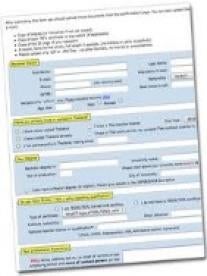
A recent example is a claim filed in Virginia, which focuses on the employer's online job application. The process asks potential employees whether they are willing to allow the company to obtain a consumer report or criminal background check on them. Applicants must then click a button labeled either "Accept" or "Decline." The claim alleges that for purposes of the FCRA, an electronic disclosure is not one made "in writing" and that an electronic signature (Accept/Decline) does not satisfy the requirements of the act.

As it relates to employers conducting background checks on prospective employees, the FCRA requires that a person may not procure a consumer report for employment purposes with respect to any consumer, unless (1) a clear and conspicuous disclosure has been made in writing to the applicant at any time before the report is procured, in a document that consists solely of the disclosure that a consumer report may be obtained for employment purposes; and (2) the consumer has authorized in writing the procurement of the report by that person.

Electronic disclosures of this sort have traditionally been viewed as falling under the Electronic Signatures in Global and National Commerce Act ("E-Sign"). However, this claim challenges this understanding of E-Sign by alleging that the law does not apply to job applicants, but instead only to consumers, which it defines as an individual who obtains products or services.

Under the FCRA, employers may be liable to each class member for up to $1,000.00 or actual damages, plus punitive damages and attorneys' fees and costs. So far this year, two companies have agreed to multimillion-dollar settlements in similar cases.

We strongly recommend that employers review their online job application process to ensure that it does not run afoul of the FCRA and obtain competent labor counsel to address any concerns. 

© 2012 Varnum LLP

About the Author

Associate

Luis focuses his practice on immigration and refugee law, international law, civil liberties, and international trade and finance. He has first chair trial experience in a wide variety of employment and immigration-based cases, as well as I-9 audits, visas, waivers, adjustments of status and naturalization matters. He is fluent in Spanish and English.

Luis’ experience spans the United States, Mexico and Europe. With a background in international business law and finance, Luis worked for a large international corporate law firm in Mexico City where he worked on foreign direct...

616-336-6742

About the Author

Partner

Pat White's practice concentrates on the full spectrum of civil rights issues, race and gender disability matters, free speech and electronic privacy issues in the workplace. In addition to litigation, he also does traditional labor work, including negotiation and arbitration, both for public and private sector clients. He also maintains expertise in education law, representing school districts, community colleges and colleges and universities, both with respect to employment issues as well...

616/336-6615

Boost: AJAX core statistics

Legal Disclaimer

You are responsible for reading, understanding and agreeing to the National Law Review's (NLR’s) and the National Law Forum LLC's  Terms of Use and Privacy Policy before using the National Law Review website. The National Law Review is a free to use, no-log in database of legal and business articles. The content and links on www.NatLawReview.com are intended for general information purposes only. Any legal analysis, legislative updates or other content and links should not be construed as legal or professional advice or a substitute for such advice. No attorney-client or confidential relationship is formed by the transmission of information between you and the National Law Review website or any of the law firms, attorneys or other professionals or organizations who include content on the National Law Review website. If you require legal or professional advice, kindly contact an attorney or other suitable professional advisor.  

Some states have laws and ethical rules regarding solicitation and advertisement practices by attorneys and/or other professionals. NLR does not accept advertising from attorneys or law firms. The National Law Review is not a law firm nor is www.NatLawReview.com  intended to be an advertisement or a referral service for attorneys and/or other professionals. The NLR does not wish, nor does it intend, to solicit the business of anyone or to refer anyone to an attorney or other professional.  NLR does not answer legal questions nor will we refer you to an attorney or other professional if you request such information from us. 

Under certain state laws the following statements may be required on this website and we have included them in order to be in full compliance with these rules. The choice of a lawyer or other professional is an important decision and should not be based solely upon advertisements. Attorney Advertising Notice: Prior results do not guarantee a similar outcome. Statement in compliance with Texas Rules of Professional Conduct. Unless otherwise noted, attorneys are not certified by the Texas Board of Legal Specialization, nor can NLR attest to the accuracy of any notation of Legal Specialization or other Professional Credentials.



