


Advertisement

May 24, 2013

NLRB Postpones Effective Date for Employee Rights Posting Rule

The National Labor Relations Board (NLRB) has postponed the effective date for its employee rights posting rule until Jan. 31, 2012. The previous deadline was Nov. 14, 2011.

The extension of the deadline came after a federal judge asked for more time to consider arguments raised in one of several lawsuits challenging the rule, though an NLRB spokesperson stated that the extension was not related to those lawsuits. Rather, the Board said, it delayed the implementation date "to allow for enhanced education and outreach" to small and medium-sized businesses in particular.

The Board's press release, posted at www.nlrb.gov, states "[t]he decision to extend the rollout period followed queries from businesses and trade organizations indicating uncertainty about which businesses fall under the Board's jurisdiction, and was made in the interest of ensuring broad voluntary compliance. No other changes in the rule, or in the form or content of the notice, will be made."

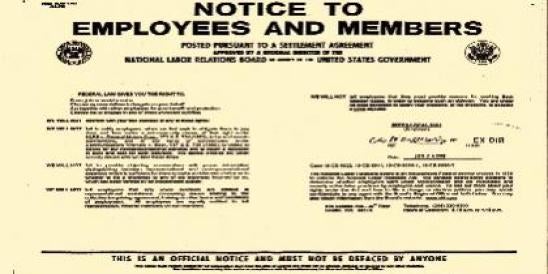
The Board's final rule requires businesses to post an 11 x 17 notice that alerts workers to their rights under Section 7 of the National Labor Relations Act (NLRA), including the right to organize and join a union. The rule also requires businesses that use the Internet or an intranet site to post human resources-related information to post the NLRB notice on those sites as well.


© 2013 BARNES & THORNBURG LLP

About the Author

Barnes & Thornburg’s Labor and Employment Law Department is one of the fastest-growing labor groups in the nation. Two qualities set us apart: Our passion for what we do, and the pride we take in helping clients achieve their business goals. To succeed in the competitive global marketplace, our clients must not only meet but exceed their customers’ expectations. We share this objective, offering superior service, innovative ideas and an understanding of the challenges our clients face.

Our Services
The Labor and Employment Law group offers comprehensive...

317-231-7513

Boost: AJAX core statistics

Legal Disclaimer

You are responsible for reading, understanding and agreeing to the National Law Review's (NLR’s) and the National Law Forum LLC's  Terms of Use and Privacy Policy before using the National Law Review website. The National Law Review is a free to use, no-log in database of legal and business articles. The content and links on www.NatLawReview.com are intended for general information purposes only. Any legal analysis, legislative updates or other content and links should not be construed as legal or professional advice or a substitute for such advice. No attorney-client or confidential relationship is formed by the transmission of information between you and the National Law Review website or any of the law firms, attorneys or other professionals or organizations who include content on the National Law Review website. If you require legal or professional advice, kindly contact an attorney or other suitable professional advisor.  

Some states have laws and ethical rules regarding solicitation and advertisement practices by attorneys and/or other professionals. NLR does not accept advertising from attorneys or law firms. The National Law Review is not a law firm nor is www.NatLawReview.com  intended to be an advertisement or a referral service for attorneys and/or other professionals. The NLR does not wish, nor does it intend, to solicit the business of anyone or to refer anyone to an attorney or other professional.  NLR does not answer legal questions nor will we refer you to an attorney or other professional if you request such information from us. 

Under certain state laws the following statements may be required on this website and we have included them in order to be in full compliance with these rules. The choice of a lawyer or other professional is an important decision and should not be based solely upon advertisements. Attorney Advertising Notice: Prior results do not guarantee a similar outcome. Statement in compliance with Texas Rules of Professional Conduct. Unless otherwise noted, attorneys are not certified by the Texas Board of Legal Specialization, nor can NLR attest to the accuracy of any notation of Legal Specialization or other Professional Credentials.

