

 i
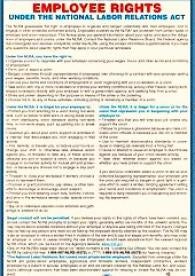
iThe National Labor Relations Board published new regulations that require private sector employers to post employee rights under the National Labor Relations Act. The notice requirement is fulfilled by posting a NLRA rights poster which will be provided by the Board and will be available on the Board’s website. The Board permits employers to use a commercial poster that includes other required employee notifications, provided that the commercial poster meets the signage specifications of 11 x 17 inches.
Poster highlights an employee’s right to
- Discuss wages and benefits and other terms and conditions of employment or union organizing with your co-workers or a union.
- Organize a union to negotiate with their employer concerning your wages, hours, and other terms and conditions of employment.
- Wear union hats, buttons, t-shirts, and pins in the workplace except under special circumstances.
Employers must include the notification electronically—a company website or intranet—wherever they customarily communicate with their employees. The notice must be displayed just like any other notices the employer posts. Employers can either link to the NLRB or they can host a verbatim copy of the Board’s notice. The link to the notice must read: “Employee Rights under the National Labor Relations Act.”
The Board also requires employers to post notification posters in multiple languages, if at least 20% of the employees speak a language other than English and would not understand the English notification. Employers must do this for every group of employees that meets the 20% threshold. Alternatively, employers can post the notices in the language spoken by the largest 20% group of non English speakers, and notify the remaining employees individually. A similar rule applies to electronic postings. Employers are required to post a link to the Board’s notification for every group that meets the 20% threshold; however, employers are obligated only to use the notices provided by the Board, so if the Board does not provide a notice in a particular language, the employer does not have an independent obligation to provide it.
There are strong incentives for employers to comply with the new regulations. First, noncompliance itself can create an unfair labor practice. Second, the rule also can toll the statute of limitations on other unfair labor practice charges. Perhaps the most compelling reason to comply with this Regulation is that noncompliance may be seen as an unlawful motive for other unfair labor practice claims.
Prior to the November 14th deadline, it is important that supervisors at all employer facilities know the warning signs of unionization and how to respond. Supervisors should also be empowered with the information necessary to articulate the company’s position of a union-free workplace with credibility. Likewise, employers should also institute policies that guide employees about union solicitation, union access to facilities and employee uniform policies. By implementing these steps before the November 14th deadline, employers can best prepare themselves for any potential unionization efforts.




