
 i
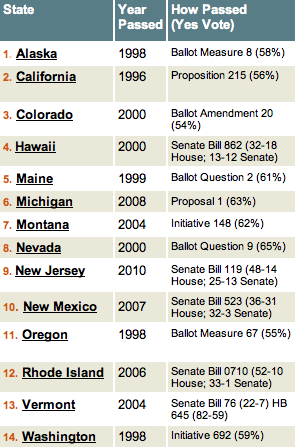
iAt the time of this writing, there are 14 states that have legalized the use of marijuana for medicinal purposes. This, of course, poses quite a few problems regarding the employment of individuals who are prescribed pot. Probably the most pressing is the issue of workers compensation for employees who use medical marijuana and are injured on the job.
Since the Obama administration announced last year that it would end raids on distributors of medical marijuana if such dispensaries were following their state’s laws on the matter, the number of dispensaries exploded in those 14 states (California alone has more than 2,000 of these pot depots). Below is a list of states that have enacted laws that legalize medical marijuana use (courtesy of ProCon.org)
I was curious as to some of the issues regarding employment and medical marijuana so I contacted Brett Halloran, attorney with New Jersey-based Fox Rothschild LLP.
Emily Holbrook: How far does an employer have to go to accommodate medical marijuana users? Are they required to tolerate it in the states that allow such use?
Brett Halloran: Under New Jersey’s law, an employer does not have to accommodate the use of medical marijuana at all, although it may do so if it wishes. I am not aware of any state medical marijuana law that would require an employer to accommodate the use of medical marijuana in the workplace.
Holbrook: Do employers follow state or federal law when it comes to dealing with an employee who is prescribed medical marijuana?
Halloran: Employers need to be cognizant of both federal and state law. While state law may permit the use of medical marijuana, federal law still treats the use of marijuana as a crime, regardless how or why the individual obtained the drug. Therefore, at least under federal, use of medical marijuana is still a crime in all 50 states. In part because of that reason, courts have generally held that employers in states that permit the use of medical marijuana are not required to accommodate its use in the workplace.
Holbrook: How do some employers’ “zero-tolerance” programs need to adjust for the legalization of medical marijuana in some states?
Halloran: For the time being, employers may continue to have “zero tolerance” for workplace drug use, including the use of marijuana, in states that permit medical marijuana. That said, however, employers should review any such policies, including drug-testing policies, to make clear that any prohibition on the use of illegal drugs extends to marijuana prescribed and taken under state medical marijuana laws. By taking an explicit position on the use of medical marijuana by employees, employers can help insulate themselves from a claim, in the context of a later disability discrimination suit, that the employer’s stated reason for a resulting adverse job action was mere pretext.
That brings us to a recent case in Michigan involving a Walmart employee who was fired for testing positive for marijuana during a employer-issued drug test. The 30-year-old employee, who was prescribed marijuana to treat symptoms of an inoperable brain tumor and sinus cancer, was issued the drug test after an on-the-job injury, which is Walmart’s policy. Is this fair? The American Civil Liberties Union doesn’t think so — they immediately filed a lawsuit.
“No patient should be forced to choose between adequate pain relief and gainful employment,” Scott Michelman, a staff attorney with the ACLU Drug Law Reform Project told CNN. “And no employer should be allowed to intrude upon private medical choices made by employees in consultation with their doctors.”
As you have probably guessed, the Walmart employee of five years has also filed a lawsuit. In Walmart’s defense, however, they claimed that “like other companies, we have to consider the overall safety of our customers and our associates, including Mr. Casias, when making a difficult decision like this.”
The issue of medical marijuana in the workplace will only become more important and widespread as more states are set to legalize its medicinal use.
The above article is reprinted from the Risk Management Monitor - the official blog of Risk Management magazine.