
May 22, 2012

The Countries Most at Risk for Energy Security

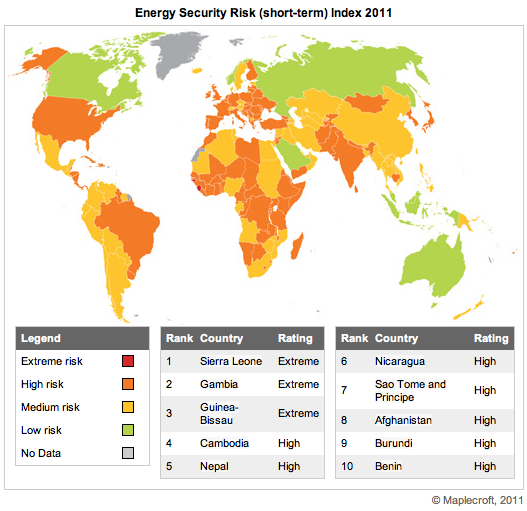
Achieving a stable energy supply in times of political upheaval, overpopulation, dwindling traditional resources and a transition to a low carbon world is downright challenging. And for some countries that challenge seems nearly impossible, according to risk analyst firm Maplecroft, which rated the following countries at “extreme risk” for energy security:

  1. Sierra Leone
  2. Gambia
  3. Guinea-Bissau

The area is commonly known for severe political conflicts, corruption and frequent violence, which further weakens already-fragile communities and governments. In the case of the one country most at risk for energy security, Maplecroft found that:

Sierra Leone emerged from a decade of civil war in 2002 and despitereconstruction efforts and recent economic growth, it is the worst performing country in the Energy Security Index (short term). Sierra Leone was also categorized as extreme risk in the 2011 Energy Security Index (short term). Nearly 10 years after the end of the war only 10% of the country’s population has access to electricity and the supply is erratic and limited to major towns.36 This highlights the lasting effect that conflict can have on the energy security and infrastructure in vulnerable nations.

But these West African countries are not the only ones at risk for energy security. Most of the G-7 nations are included in the short-term “high risk” category, including Italy, Japan, UK, Germany, France and the USA.

The world’s second largest consumer of energy, the USA, rates as ‘high risk’ in the short-term, primarily because of the high imports of fossil fuels and electricity needed to support its colossal demand for energy. The largest percentage of US oil imports come from Middle Eastern countries – leaving the country at continual high risk of supply interruption and price shocks. In 2008, the US imported an average of 12.9 million barrels of oil per day, which represents 15.10% of world production in that year, with 23.36% coming from the MENA region.

Canada is the only G-7 nation rated as “low risk,” most likely because of the country’s abundant energy production and exporting business, coupled with its wealth of energy expertise, science and technology.

Japan’s ranking as “high risk” was due to many factors, including the earthquake and tsunami in March, which severely damaged the country’s ability to generate energy. There is a silver lining, however, as Prime Minister Naoto Kan recently unveiled plans to bring down the cost of solar power generation by 2010 and to install solar panels in 10 million Japanese homes.

Risk Management Magazine and Risk Management Monitor. Copyright 2012 Risk and Insurance Management Society, Inc. All rights reserved.

About the Author

Editor

Emily Holbrook is the editor of Risk Management magazine and the Risk Management Monitor blog.

212-655-5915

Boost: AJAX core statistics

Legal Disclaimer

You are responsible for reading, understanding and agreeing to the National Law Review's (NLR’s) and the National Law Forum LLC's  Terms of Use and Privacy Policy before using the National Law Review website. The National Law Review is a free to use, no-log in database of legal and business articles. The content and links on www.NatLawReview.com are intended for general information purposes only. Any legal analysis, legislative updates or other content and links should not be construed as legal or professional advice or a substitute for such advice. No attorney-client or confidential relationship is formed by the transmission of information between you and the National Law Review website or any of the law firms, attorneys or other professionals or organizations who include content on the National Law Review website. If you require legal or professional advice, kindly contact an attorney or other suitable professional advisor.  

Some states have laws and ethical rules regarding solicitation and advertisement practices by attorneys and/or other professionals. NLR does not accept advertising from attorneys or law firms. The National Law Review is not a law firm nor is www.NatLawReview.com  intended to be an advertisement or a referral service for attorneys and/or other professionals. The NLR does not wish, nor does it intend, to solicit the business of anyone or to refer anyone to an attorney or other professional.  NLR does not answer legal questions nor will we refer you to an attorney or other professional if you request such information from us. 

Under certain state laws the following statements may be required on this website and we have included them in order to be in full compliance with these rules. The choice of a lawyer or other professional is an important decision and should not be based solely upon advertisements. Attorney Advertising Notice: Prior results do not guarantee a similar outcome. Statement in compliance with Texas Rules of Professional Conduct. Unless otherwise noted, attorneys are not certified by the Texas Board of Legal Specialization, nor can NLR attest to the accuracy of any notation of Legal Specialization or other Professional Credentials.