

Advertisement

May 22, 2013

Countries Most Vulnerable to Economic Losses


Natural disasters in any form wreak havoc not only on the property and residents of the area affected, but also on its economic stability. Risk intelligence company Maplecroft set out to answer the question of which countries are most vulnerable to economic losses from natural disasters.

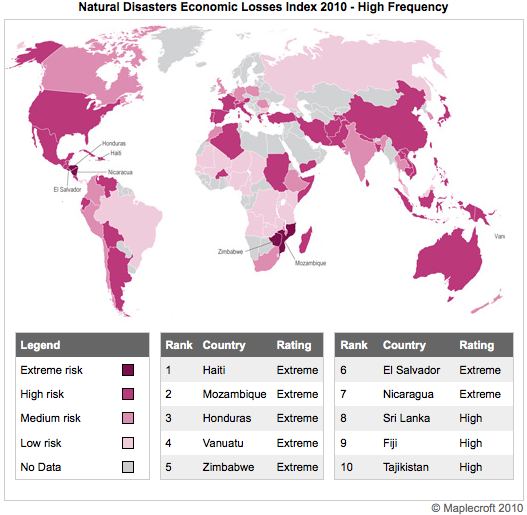
To answer this, they used their Natural Disasters Economic Loss Index (NDELI), which evaluates the economic impact of “earthquakes, volcanic eruptions, tsunamis, storms, flooding, drought, landslides, extreme temperatures and epidemics between 1980 and 2010.”

The results highlighted the top 10 most vulnerable countries as:

  1. Haiti
  2. Mozambique
  3. Honduras
  4. Vanuatu
  5. Zimbabwe
  6. El Salvador
  7. Nicaragua
  8. Sri Lanka
  9. Fiji
  10. Tajikistan

As for industrialized economies, Italy, Japan, China, USA, Spain and France all ranked in the “high risk” category.

“When economic losses are taken as absolute figures, it is predominantly the industrialised countries, such as USA and China, that shoulder the greatest costs,” explained Maplecroft Environmental Analyst, Dr Anna Moss. “However, when losses are calculated as a percentage of GDP, it is developing countries that are most exposed. For example, the USA’s losses from the 1997-1998 El Niño were US$ 1.96 billion, or 0.03 percent of GDP, whereas in Ecuador, economic losses were US$ 2.9 billion, or 14.6 percent of GDP.”

Maplecroft says that the magnitude 7.0 earthquake that struck Haiti in January cost the country close to $8 billion, or 73% of annual GDP. As for number two Mozambique, it’s the increasing amount of flooding over the last decade. The World Bank has reported that Mozambique is at “increasing risk from storm surges . . . due to climate change and estimates that 41% of the country’s coastal area and 52% of coastal GDP is vulnerable.”

Says Profesor Alyson Warhurst, CEO of Maplecroft:

“Climate change has the potential to raise global temperatures and affect weather patterns – the fear for insurers is that this will lead to more frequent and extreme hydro-meteorological related losses.”

If you add up the costs associated with the earthquakes in Haiti and Chile, plus this year’s Atlantic hurricane season, the cost of natural disasters to the insurance industry in 2010 could reach $110 billion worldwide, according to Swiss Re. A frightening figure to say the least.
Picture 4


The above article is reprinted from the Risk Management Monitor - the official blog of Risk Management magazine.


Reprinted with permission from the Risk Management Monitor. Copyright 2010 Risk and Insurance Management Society, Inc. All rights reserved.

About the Author

Editor

Emily Holbrook is the editor of Risk Management magazine and the Risk Management Monitor blog.

212-655-5915

Boost: AJAX core statistics

Legal Disclaimer

You are responsible for reading, understanding and agreeing to the National Law Review's (NLR’s) and the National Law Forum LLC's  Terms of Use and Privacy Policy before using the National Law Review website. The National Law Review is a free to use, no-log in database of legal and business articles. The content and links on www.NatLawReview.com are intended for general information purposes only. Any legal analysis, legislative updates or other content and links should not be construed as legal or professional advice or a substitute for such advice. No attorney-client or confidential relationship is formed by the transmission of information between you and the National Law Review website or any of the law firms, attorneys or other professionals or organizations who include content on the National Law Review website. If you require legal or professional advice, kindly contact an attorney or other suitable professional advisor.  

Some states have laws and ethical rules regarding solicitation and advertisement practices by attorneys and/or other professionals. NLR does not accept advertising from attorneys or law firms. The National Law Review is not a law firm nor is www.NatLawReview.com  intended to be an advertisement or a referral service for attorneys and/or other professionals. The NLR does not wish, nor does it intend, to solicit the business of anyone or to refer anyone to an attorney or other professional.  NLR does not answer legal questions nor will we refer you to an attorney or other professional if you request such information from us. 

Under certain state laws the following statements may be required on this website and we have included them in order to be in full compliance with these rules. The choice of a lawyer or other professional is an important decision and should not be based solely upon advertisements. Attorney Advertising Notice: Prior results do not guarantee a similar outcome. Statement in compliance with Texas Rules of Professional Conduct. Unless otherwise noted, attorneys are not certified by the Texas Board of Legal Specialization, nor can NLR attest to the accuracy of any notation of Legal Specialization or other Professional Credentials.


