

May 23, 2012

Financial Institutions Further Embracing Enterprise Risk Management "ERM": Deloitte

The failure of numerous banks and financial institutions during the past several years has shown, in its harshest fashion, that such institutions did not fully embrace a strict risk management regimen. Things have changed since then, however, and Deloitte’s Global Risk Management Survey shows just that.

Deloitte surveyed 131 financial institutions from around the world with total assets of more than $17 trillion. The following are a few key findings from the report:

  • Roughly 90% of institutions had a defined risk governance model and approach, and 78% reported that their board of directors had approved their risk management policy or ERM framework
     
  • 86% of institutions had a CRO or equivalent position, up from 73% in 2008 and 65% in 2002
     
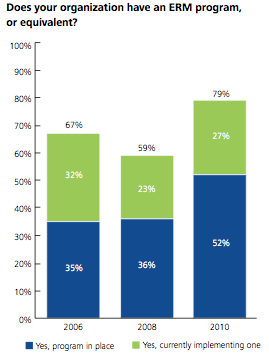
  • 79% of institutions reported having an ERM program or equivalent in place or in progress, an increase from 59% in 2008 (see below)
  • For insurance institutions subject to Solvency II, 70% or more said they plan to focus over the next 12 months on program initiation, gap analysis, and planning; risk governance; and Own Risk and Solvency Assessment (ORSA)
     
  • 88% of institutions used stress testing for risk factors affecting their credit portfolio, an increase from 79% in 2008, while 74% conducted stress testing for market risk in their trading book
     
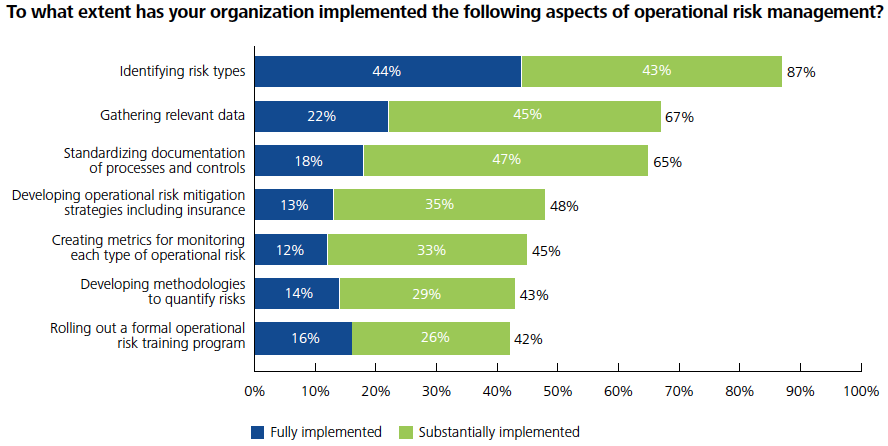
  • 60% of executives considered their operational risk assessments and internal loss event data to be extremely or very well developed, an increase of 40% in 2008 (see below)
In all, Deloitte’s report is optimistic. It clearly shows financial institutions (finally) taking certain aspects of risk management, such as ERM, capital reserves, governance and, to an extent, technology risk assessments, very seriously. This is promising and can provide a certain amount of relief to those worrying about another catastrophic financial collapse of the U.S. economy. Of course, we can never say never, but with financial institutions continuing to fully embrace risk management in all its forms, we can all sleep a little better.


Risk Management Magazine and Risk Management Monitor. Copyright 2012 Risk and Insurance Management Society, Inc. All rights reserved.

About the Author

Editor

Emily Holbrook is the editor of Risk Management magazine and the Risk Management Monitor blog.

212-655-5915

Boost: AJAX core statistics

Legal Disclaimer

You are responsible for reading, understanding and agreeing to the National Law Review's (NLR’s) and the National Law Forum LLC's  Terms of Use and Privacy Policy before using the National Law Review website. The National Law Review is a free to use, no-log in database of legal and business articles. The content and links on www.NatLawReview.com are intended for general information purposes only. Any legal analysis, legislative updates or other content and links should not be construed as legal or professional advice or a substitute for such advice. No attorney-client or confidential relationship is formed by the transmission of information between you and the National Law Review website or any of the law firms, attorneys or other professionals or organizations who include content on the National Law Review website. If you require legal or professional advice, kindly contact an attorney or other suitable professional advisor.  

Some states have laws and ethical rules regarding solicitation and advertisement practices by attorneys and/or other professionals. NLR does not accept advertising from attorneys or law firms. The National Law Review is not a law firm nor is www.NatLawReview.com  intended to be an advertisement or a referral service for attorneys and/or other professionals. The NLR does not wish, nor does it intend, to solicit the business of anyone or to refer anyone to an attorney or other professional.  NLR does not answer legal questions nor will we refer you to an attorney or other professional if you request such information from us. 

Under certain state laws the following statements may be required on this website and we have included them in order to be in full compliance with these rules. The choice of a lawyer or other professional is an important decision and should not be based solely upon advertisements. Attorney Advertising Notice: Prior results do not guarantee a similar outcome. Statement in compliance with Texas Rules of Professional Conduct. Unless otherwise noted, attorneys are not certified by the Texas Board of Legal Specialization, nor can NLR attest to the accuracy of any notation of Legal Specialization or other Professional Credentials.

