
Advertisement

May 25, 2013

The Risks of Oil-Producing Countries

Risk Management (RIMS)

Understanding the unique risks of oil-producing countries is not easy. From political to economic to security risks, there are many and they are far-reaching.

I was lucky enough to participate in a webinar yesterday on this very topic. Leading the presentation was Fareed Mohamedi, partner and head of markets and country strategies for PFC Energy and Raad Alkadiri, partner and head of PFC Energy.

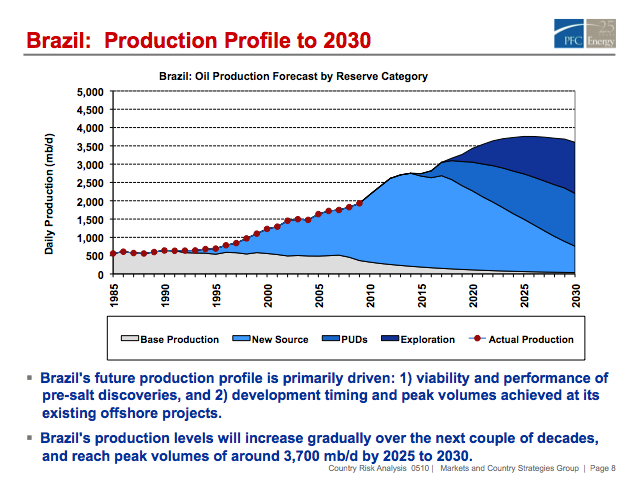
The webinar was thought-provoking and insightful, offering a glimpse into the oil production of such countries as Iraq, Iran, Russia and Brazil.
Picture 21

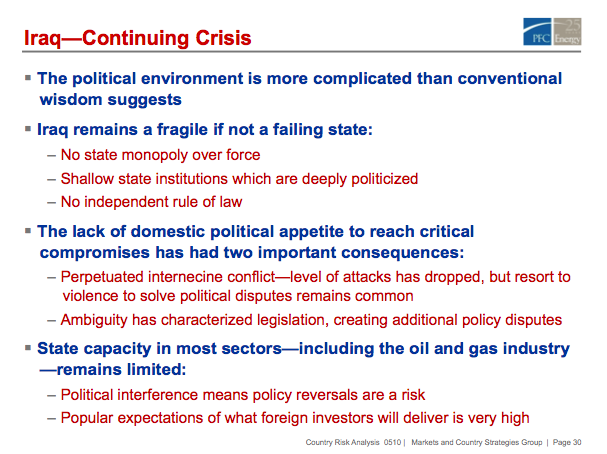
Iraq, according to the U.S. Energy Information Administration, holds more than 112 billion barrels of oil — the world’s second largest proven reserve — and also contains 110 trillion cubic feet of natural gas, and is a focal point for regional and international security issues. Mohamedi and Alkidiri see this oil-rich country as a ongoing risk.
Picture 22

The presenters also focused on OPEC constraints on oil production and the eventual quota applied to Iraq, stating that “OPEC may be able to live with maximum Iraqi production of 6 mmb/d by 2017 assuming relatively benign supply/demand fundamentals, but the risks are all on the downside.”

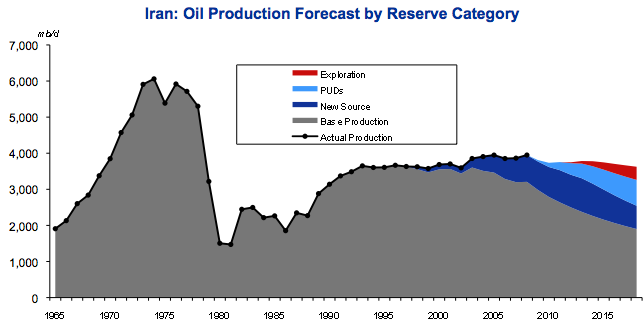
But let’s not leave out Iraq’s neighbor and fellow oil-rich country, Iran. According to PFC Energy, the country’s oil production forecast looks something like this:
Picture 23

But this excessive production doesn’t come without some consequences. Iran faces severe natural decline rates from its reservoirs, forcing Iran to rely heavily on proven undeveloped reserves (PUDs). However, the country’s unstable investment climate is a downside risk for PUD development. And as the webinar stated, “Iran’s production struggles will continue, or even worsen in the future due to geological constraints, lack of domestic technical capacity and the impact of sanctions on investment.”

U.S. dependency on foreign oil may decrease as the Obama administration opens up even more water for exploratory drilling. But, as we have seen recently with the Deepwater Horizon, that too comes with extreme risks.

The above article is reprinted from the Risk Management Monitor - the official blog of Risk Management magazine.


Reprinted with permission from the Risk Management Monitor. Copyright 2010 Risk and Insurance Management Society, Inc. All rights reserved.

About the Author

Editor

Emily Holbrook is the editor of Risk Management magazine and the Risk Management Monitor blog.

212-655-5915

Boost: AJAX core statistics

Legal Disclaimer

You are responsible for reading, understanding and agreeing to the National Law Review's (NLR’s) and the National Law Forum LLC's  Terms of Use and Privacy Policy before using the National Law Review website. The National Law Review is a free to use, no-log in database of legal and business articles. The content and links on www.NatLawReview.com are intended for general information purposes only. Any legal analysis, legislative updates or other content and links should not be construed as legal or professional advice or a substitute for such advice. No attorney-client or confidential relationship is formed by the transmission of information between you and the National Law Review website or any of the law firms, attorneys or other professionals or organizations who include content on the National Law Review website. If you require legal or professional advice, kindly contact an attorney or other suitable professional advisor.  

Some states have laws and ethical rules regarding solicitation and advertisement practices by attorneys and/or other professionals. NLR does not accept advertising from attorneys or law firms. The National Law Review is not a law firm nor is www.NatLawReview.com  intended to be an advertisement or a referral service for attorneys and/or other professionals. The NLR does not wish, nor does it intend, to solicit the business of anyone or to refer anyone to an attorney or other professional.  NLR does not answer legal questions nor will we refer you to an attorney or other professional if you request such information from us. 

Under certain state laws the following statements may be required on this website and we have included them in order to be in full compliance with these rules. The choice of a lawyer or other professional is an important decision and should not be based solely upon advertisements. Attorney Advertising Notice: Prior results do not guarantee a similar outcome. Statement in compliance with Texas Rules of Professional Conduct. Unless otherwise noted, attorneys are not certified by the Texas Board of Legal Specialization, nor can NLR attest to the accuracy of any notation of Legal Specialization or other Professional Credentials.